
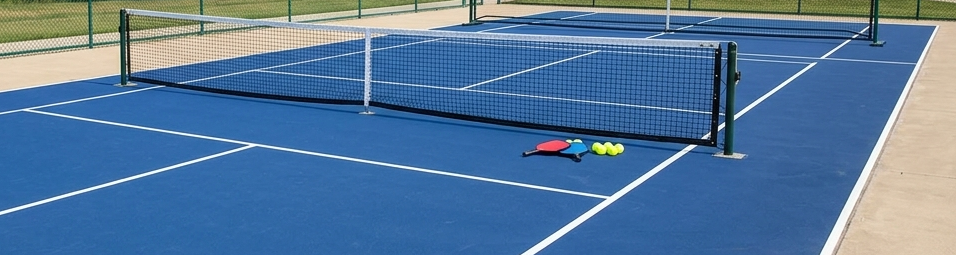
Concrete Pickleball Courts in Los Angeles
Do You Need Saw Cuts or Expansion Joints?
It’s not an overstatement to say that pickleball has taken over Los Angeles. And why not? With our Mediterranean climate, you can play outside pretty much year-round. Pickleball courts take up less space than traditional tennis. And it’s just easier for newcomers to give it a try.
More and more, homeowners, HOAs, schools and municipalities are building new concrete pickleball courts to meet the demand.
One of the most frequently misunderstood (and possibly technical) questions about pickleball courts centers on their installation. When a concrete pickleball court is installed, should you use saw cuts or expansion joints? This may seem like a highly technical question, but it’s one you have to get right in order to have a pickleball court in good working order for years to come.
Why Concrete Cracks in LA
By its very nature, concrete is going to shrink or expand due to temperature and moisture. Think of it as the concrete breathing. When it’s hotter, the concrete will expand and when the temperature cools, it will contract.
While L.A. concrete doesn’t have to deal with frost-heaving action as in other regions, we do get some pretty wild temperature fluctuations over the course of a day, with intense sunshine and seismic activity on occasion.
This creates stress on a slab of concrete. Without proper planning, that stress will cause uncontrolled cracking right in the playing surface.
That’s where saw cuts and expansion joints come in.
What Are Saw Cuts In Pickleball Courts?
Think of saw cuts, or control joints, as planned cracks. They are added in while pouring the concrete. They are intended to manipulate when cracking happens, not just let it happen wherever.
In pickleball courts, the saw cuts are usually positioned:
- Along the net line
- Among courts in multi-court setups
- Out of primary playing areas where practical
Many Los Angeles pickleball court builders don’t want to see saw cuts. It doesn’t create a clean aesthetic, particularly for residential or club-level courts. That’s why most saw cuts are discretely added to areas where they won’t be seen by players.
Expansion Joints vs Control Joints: What is the Difference?
Expansion joints and control joints are often confused. However, they have very distinct jobs.
- Control joints (saw cuts): Promote cracks to occur only in specific locations
- Expansion control joints: Permit concrete slabs to shift independently without placing stress from expansion or contraction
Expansion joints are more frequent on slabs near buildings and where courts touch sidewalks or retaining walls. On a pickleball slab, they are placed thoughtfully to avoid any disruption in play.
Concrete Slab: Top Choices for Los Angeles Pickleball Courts
The type of slab you choose will often determine whether saw cuts or expansion joints need to be used.
Post-Tensioned Concrete Slabs
- Highly resistant to cracking
- Often do not require saw cuts
- Perfect for the soil in Los Angeles
- Upfront cost is higher with lower long-term maintenance.
Reinforced Concrete Slabs (Rebar)
- More affordable
- Typically require saw cuts
- Utilized for backyard and local park courts
Some Los Angeles contractors will do only one saw cut below the net line of a pickleball court to preserve as much crack control as possible while still having some aesthetic distinction.
Saw Cuts: How They Impact Court Performance
From a player point of view, set joints on the play surface can ruin games. Raised or low joints can lead to erratic ball rebound and trip points.
To prevent this, professional installers:
- Fill saw cuts with acrylic or elastomeric crack fillers
- Multiple layers of sport court coatings can be applied
- Inspect joints often during cycles of resurfacing
In cities such as Los Angeles, where courts are can be played year-round, it is important to have proper joint filling for longevity.
LA Courts and Maintenance
Even with the best construction, shifting is going to happen. There are some things that homeowners, and facility managers can do to extend the life of their pickleball court:
- Periodically re-fill the jointing every few years.
- Resurface every 4–6 years on average, or as required by use
These ongoing costs can be drastically decreased by selecting the right slab design at the outset.
Lessons To Be Learned For Los Angeles Pickleball Court Projects
If you are building or resurfacing a pickleball court in Los Angeles:
- Saw cuts are not always necessary, especially for post-tensioned slabs.
- Concrete courts generally require some control joints
- Reduce seams in court play surfaces
- Good fillers and coatings are the key to long life
When you are choosing a contractor, pick one who is knowledgeable in the construction of sports courts. This guarantees your court will perform as expected and hold up to our local climate.